
 Melbourne, Victoria (Australia)

How to Make AI Agents Book, Buy and Enquire on Your Site (2026 Guide)
 16 October 2026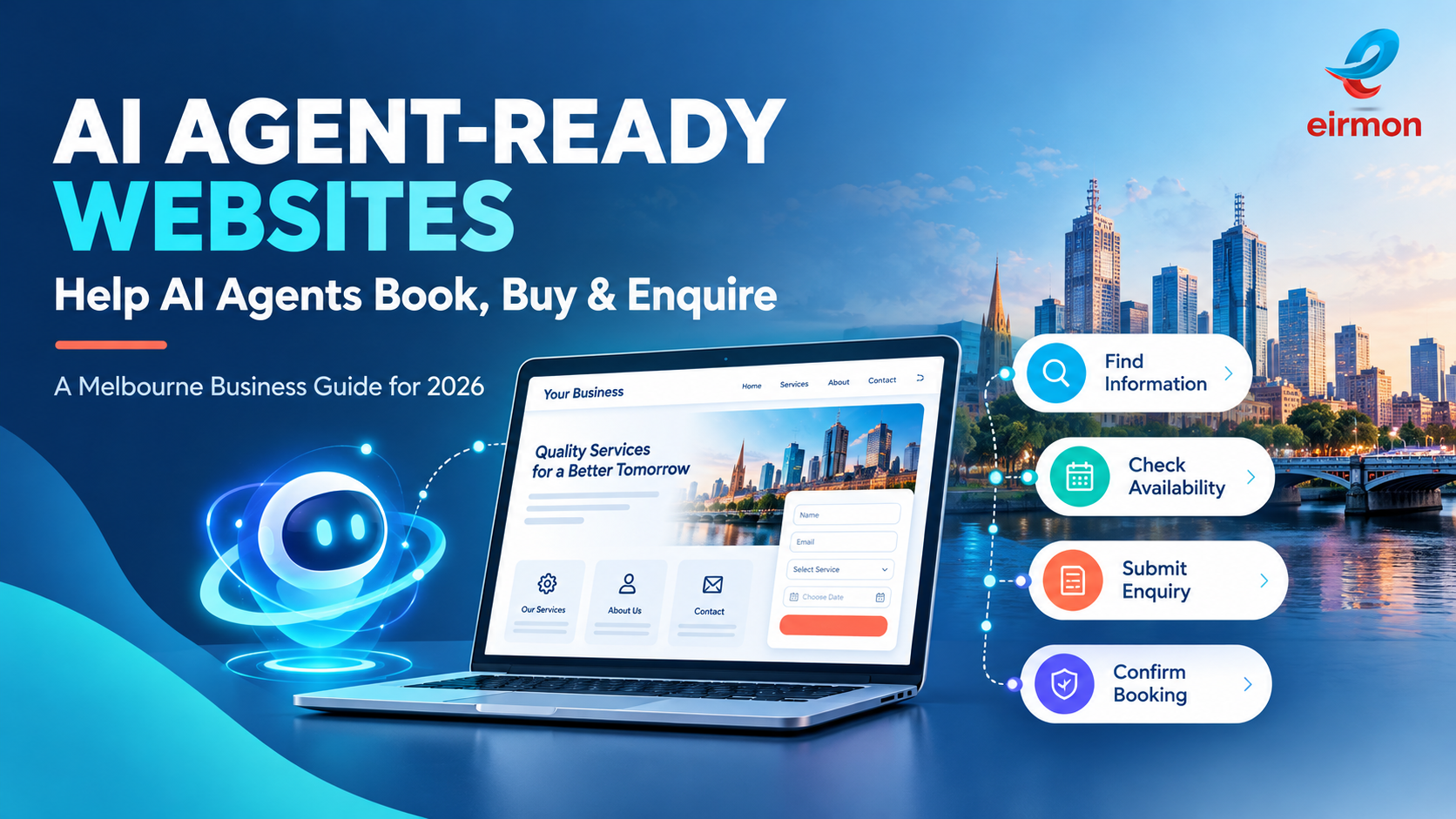
Introduction: Is Your Website Ready for AI Agents?
Imagine a potential customer visiting your website through an AI assistant. Instead of simply reading your service pages, the assistant helps the customer compare options, check availability, complete a booking, or submit an enquiry.
Now imagine your website can support that process with clear information, accessible services, secure transactions and reliable integrations. This is where AI agent-ready websites come into the picture.
As artificial intelligence evolves, businesses are exploring how AI agents can do more than answer questions. Depending on their capabilities and permissions, these systems can interact with software, retrieve information, and perform specific tasks on behalf of users. With forward-thinking digital strategies from Eirmon Solutions, businesses can explore ways to improve their online presence and prepare their websites for emerging AI-driven customer experiences.
For Melbourne businesses, this creates opportunities to improve customer experiences, reduce repetitive administrative work and simplify online transactions.
However, making a website ready for AI agents involves more than adding a chatbot. Businesses need to consider website structure, data accessibility, booking systems, payment security, automation workflows and human oversight.
The big question is: Can your website help customers move from discovering your business to completing an action?
In this guide, we explore how Melbourne businesses can prepare their websites for AI-assisted bookings, purchases and enquiries in 2026.
1. What is an AI Agent-Ready Website?
An AI agent-ready website is a website designed or equipped to let authorised AI systems access relevant information and perform supported tasks through reliable interfaces.
Traditional websites primarily present information and allow visitors to interact through forms, menus, buttons and checkout pages
An AI agent-ready website can go further by supporting structured interactions that allow compatible AI systems to retrieve information or initiate actions.
For example:
- A service business: An AI agent checks appointment availability and helps a customer request a booking.
- An online store: An AI shopping assistant retrieves product details and helps a customer navigate the purchasing process.
- A professional agency: An AI assistant collects project requirements and submits an enquiry.
- A hospitality business: An AI system checks availability through an authorised booking integration.
The important distinction is that an AI agent does not automatically gain access to every website function. It can only perform tasks supported by the website, its integrations, the agent's permissions and the applicable security controls.
For businesses, the opportunity is to make essential information and actions easier for compatible systems to access and use.
2. Why Melbourne Businesses Should Prepare for AI Agents
Customer expectations are changing. People increasingly expect digital services to be convenient, responsive and available when they need them.
AI agents could extend these expectations by helping customers complete multi-step tasks with less manual effort.
Consider a customer searching for a website development agency in Melbourne.
Instead of opening several websites, the customer might use an AI assistant to compare services, identify suitable providers and prepare an enquiry based on their requirements.
A business with clear service information, transparent processes and accessible enquiry options may be easier for the customer or their AI assistant to evaluate.
For Melbourne businesses, potential benefits include:
Improved customer convenience: Make it easier to find information, compare services and complete supported tasks.
Reduced repetitive work: Automate routine processes such as collecting enquiry details or sending booking confirmations.
Faster responses: Use properly configured AI systems to handle selected customer requests outside standard business hours.
More structured enquiries: Collect relevant details before passing a lead to the sales team.
Better operational efficiency: Connect website interactions with suitable customer relationship management (CRM), booking and business management systems.
These benefits depend on implementation quality. AI automation is most useful when it solves a specific business problem rather than adding complexity without a clear purpose.
3. Make Your Website Information Clear and Machine-Readable
Before an AI agent can help someone choose your services, it needs access to accurate, understandable information. A website that relies on vague descriptions, outdated prices, or confusing navigation can make it difficult for both people and automated systems to understand what the business offers. Start by reviewing your most important pages.
Your service pages should explain what you provide, who the service is for, what the process involves and how customers can get started. Where relevant, include pricing information, service limitations, operating hours, location details, frequently asked questions and clear next steps.
For example, instead of writing:
"We provide innovative digital solutions for modern businesses."
Use a more informative description:
"We provide website design and development, search engine optimisation, PPC advertising and digital marketing services for businesses seeking to improve their online presence."
The second description communicates specific services and gives customers more useful information.
Your website readiness checklist
- Use clear headings and descriptive page titles.
- Organise services into dedicated pages.
- Keep contact information accurate.
- Explain booking, payment and enquiry processes.
- Use consistent product and service details.
- Remove outdated information.
- Add relevant structured data where appropriate.
Structured data can help search engines interpret information about products, services, organisations and other entities. However, it does not automatically make a website compatible with every AI agent or guarantee visibility in AI-generated answers.
Action point: Review your homepage and your three most important service pages. Could someone unfamiliar with your business understand what you offer within a few seconds?
If not, improve the content before investing in more advanced automation.
4. Enable AI Agents to Support Online Bookings
For businesses that depend on appointments, booking convenience can directly affect customer experience.
Clinics, consultants, beauty businesses, hospitality providers and professional service companies may benefit from workflows that allow customers to check availability and request appointments digitally. An AI agent could help a customer identify a suitable service, gather the required details and access an authorised booking system.
For example, a customer might ask for an available consultation next week. A properly integrated agent could check the booking platform, present available options and help the customer complete the reservation.
To support this process, your website needs more than a contact form.
Consider implementing:
- An online booking system with current availability.
- Clear descriptions of appointment types.
- Choose genuine service areas. Add only postcodes you actually serve and don’t add the same one twice.
- Defined booking and cancellation policies.
- Secure handling of customer information.
- Confirmation messages and reminders.
- An authorised integration for accessing booking functions.
The AI agent should check actual availability rather than inventing appointment times. It should also confirm the booking only after the booking system successfully records it.
Practical example: A Melbourne consulting business could use an AI-assisted workflow to collect a customer's requirements, check available consultation times and create a booking after receiving the customer's confirmation.
The result is a more convenient process without removing the business's control over its calendar.
5. Prepare Your Website for AI-Assisted Purchases
For eCommerce businesses, AI agents could help customers discover suitable products, compare features, check stock information and navigate checkout.
But enabling AI-assisted shopping requires accurate product data and secure transaction workflows.
Imagine a customer looking for a laptop suitable for graphic design within a particular budget. An AI shopping assistant could compare product specifications, identify relevant options and direct the customer towards an appropriate purchase.
Your website can support such experiences by providing structured product information and reliable system integrations.
Essential eCommerce improvements
Accurate product data: Maintain current product names, descriptions, specifications, prices and availability.
Clear policies: Make delivery charges, return conditions, warranties and payment options easy to find.
Secure checkout: Use established payment processors and ensure sensitive payment information is handled securely.
Reliable inventory: Connect product availability to the relevant inventory system where practical.
Controlled purchase actions: Require appropriate authorisation before an agent places an order or commits the customer to a payment.
A useful principle is to separate product discovery from transaction approval.
An AI agent may help a customer identify the right product, but purchasing should occur through an authorised process with clear confirmation.
This protects both the customer and the business from accidental orders, incorrect prices and unauthorised transactions.
6. Turn Website Enquiries into Structured Leads
Not every customer is ready to book or purchase immediately. Many want advice, a quotation, or clarification before making a decision.
This is particularly common for service businesses offering website development, custom software, branding and digital marketing.
AI agents can help collect initial requirements and direct enquiries to the appropriate team.
For example, a prospective customer contacting a Melbourne digital marketing agency might need SEO services, PPC management, or a website redesign.
An AI-assisted enquiry workflow could ask relevant questions about the customer's goals, business type, budget range and preferred contact method.
With appropriate consent and integration, the information could then be sent to the business's CRM or enquiry management system.
This can reduce repetitive communication and help sales teams understand what prospective customers need.
How to improve your enquiry workflow
- Identify the information your team needs to assess an enquiry.
- Create short, relevant questions.
- Explain why the information is being collected.
- Connect the workflow to an appropriate CRM or enquiry system.
- Confirm successful submission.
- Provide a human contact option for complex questions.
Avoid asking unnecessary questions or making the process too long.
The goal is not to collect the maximum amount of information. It is to collect the right information to help the customer move forward.
7. Connect Your Website to the Right Business Systems
An AI agent cannot reliably manage a booking, update an order, or submit a lead unless it has access to the appropriate functionality.
This is where website integrations become important.
Depending on your business requirements, useful connections may include:
- Customer relationship management systems.
- Appointment scheduling platforms.
- Inventory and eCommerce systems.
- Payment gateways.
- Customer support platforms.
- Email marketing tools.
- Business management software.
APIs, or application programming interfaces, allow compatible systems to exchange information and perform defined operations.
For example, an authorised integration might allow an AI agent to retrieve available appointments from a booking platform or create a CRM record after a customer submits an enquiry.
The integration should define exactly what the agent can read and what actions it can perform.
Sensitive actions should have additional controls and failed operations should be handled gracefully.
If an API request fails, the agent should explain that the action could not be completed rather than claiming success.
For businesses with more complex requirements, custom software development may help connect existing platforms and create workflows suited to their operations.
8. Prioritise Security, Privacy and Human Oversight
Giving AI systems access to business workflows creates opportunities, but it also introduces risks.
An agent that can access customer records, change bookings, or initiate purchases must operate within clearly defined permissions.
Businesses should apply security controls before allowing AI systems to perform important actions.
Follow these principles:
- Give each integration only the permissions it needs.
- Authenticate users and systems appropriately.
- Protect customer information during transmission and storage.
- Require confirmation for sensitive or consequential actions.
- Maintain logs of important operations.
- Set limits on automated transactions where appropriate.
- Provide a human escalation option.
- Test failure scenarios before deployment.
For example, an AI assistant may be permitted to check appointment availability without approval but require customer confirmation before creating a booking.
Similarly, it might prepare an order for review but require explicit authorisation before purchasing.
Businesses should also review applicable privacy obligations and ensure customers understand when AI is involved in an interaction.
Remember: Automation should make your service more dependable, not create new uncertainty about payments, personal information, or completed actions.
9. Measure Whether Your AI-Ready Website Is Delivering Results
A website is not successful simply because it uses AI. The important question is whether the technology improves customer experience and contributes to meaningful business outcomes. Before introducing AI agent workflows, establish a baseline using your existing website performance and operational data.
Then measure changes after implementation.
Useful metrics include:
| Metric | What It Helps You Understand |
|---|---|
| Completed bookings | Whether customers can successfully book services |
| Enquiry conversion rate | Whether website visitors become potential customers |
| Checkout completion rate | Whether customers successfully finish purchases |
| Time to complete a task | Whether the process becomes more convenient |
| Support requests | Whether automation reduces repetitive questions |
| Failed workflow rate | Whether integrations operate reliably |
| Customer satisfaction | Whether users find the experience helpful |
| Revenue from completed transactions | Whether the workflow contributes to business outcomes |
Track both efficiency and customer experience.
For example, an AI assistant might reduce the time needed to submit an enquiry but still perform poorly if it collects incorrect details. Similarly, a higher number of automated interactions is not necessarily beneficial if customers abandon the process before completing their intended action. Use measurable results to decide what to improve, expand, or discontinue.
Also Read: Grow Your Business Online with Custom Website Design
10. Your AI Agent-Ready Website Checklist for 2026
Ready to assess your website?
Use this checklist to identify your next steps.
- Website content clearly explains your services and products.
- Contact information and business details are accurate.
- Booking, purchasing and enquiry processes are straightforward.
- Product or service information is kept up to date.
- Relevant systems can exchange information securely.
- AI actions are limited to authorised functions.
- Customers receive clear confirmations of completed actions.
- Human support is available when needed.
- Privacy and security controls are in place.
- Website performance and conversion metrics are monitored.
If you have completed only a few items, start with the foundations.
Improve your content, simplify customer journeys and identify one repetitive task that could benefit from automation. Once that workflow works reliably, you can explore more advanced integrations.
You do not need to automate every part of your website at once.
How Eirmon Solutions Can Help Prepare Your Website for the AI Era
Preparing a website for AI agents requires a combination of website strategy, clear content, technical integration, security and customer-focused design.
For Melbourne businesses, the first step is understanding how customers currently interact with the website and identifying where unnecessary friction occurs.
At Eirmon Solutions, we help businesses strengthen their digital presence through website design and development, SEO, digital marketing, branding and tailored digital solutions.
Depending on your business goals, improving your website may involve simplifying enquiry forms, improving service-page content, connecting booking systems, refining conversion paths, or exploring appropriate automation opportunities.
The right solution depends on your existing technology, operational requirements and customer needs.
Want to understand whether your website is ready for the next stage of AI-driven customer experiences?
Contact Eirmon Solutions to discuss your website goals and request a free website audit. Identify opportunities to improve your website's usability, technical foundations and ability to support future digital workflows.
Conclusion: Build a Website That Does More Than Display Information
AI agent-ready websites represent an emerging opportunity for businesses that want to make digital interactions more useful and efficient.
Instead of treating your website as a static online brochure, consider how it could help customers find information, make bookings, purchase products, or submit enquiries through secure, well-designed workflows.
Start by improving your website content, making key information accessible and simplifying the actions customers need to complete. Then explore appropriate integrations, establish security controls and measure the results.
For Melbourne businesses, the objective is not to adopt AI simply because it is a growing technology trend.
It is to create a website that helps customers get things done.
By combining thoughtful website development, reliable integrations and responsible AI automation, your business can build a stronger foundation for the evolving digital customer experience.
Frequently Asked Questions (FAQs)
Author Details