 Melbourne, Victoria (Australia)

Digital Marketing vs Performance Marketing: What's the Difference?
 20 July 2026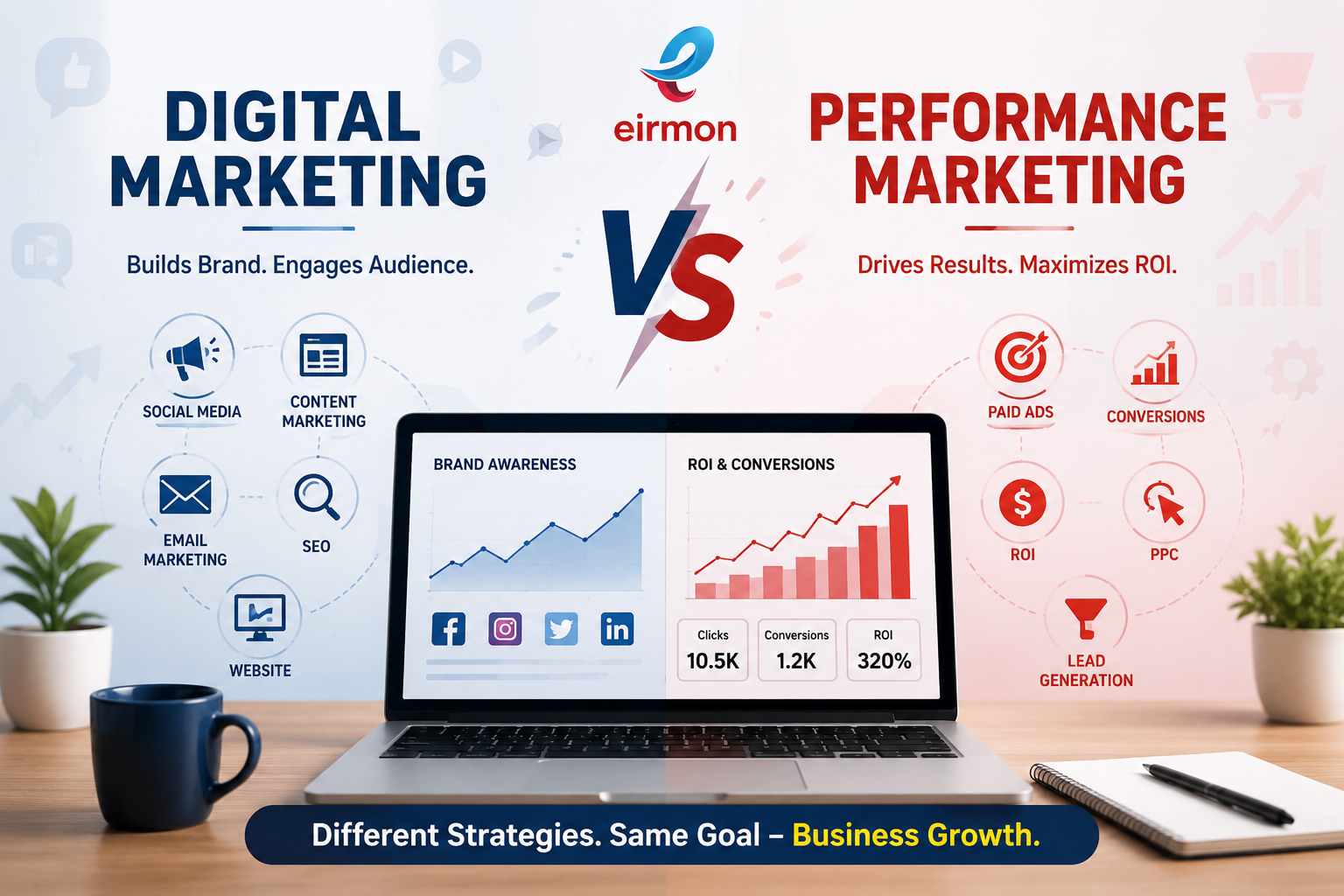
Digital marketing is the broad practice of promoting your business online — SEO, content, social media, email, and paid advertising all working together to build awareness and trust over time.
Performance marketing is the more focused discipline sitting inside it: paid campaigns like Google Ads and paid social, built around one goal — a measurable click, lead, or sale you only pay for when it actually happens. They sound similar, get used interchangeably by a lot of agencies, and cause real confusion for business owners trying to work out where their budget should go.
Both matter, and neither replaces the other. A business that only runs performance marketing gets leads today but stops appearing the moment ad spend stops. A business that only invests in digital marketing (organic SEO, content, brand) builds a lasting asset, but can wait months to see it pay off.
The businesses that grow fastest in competitive markets — including here in Melbourne — treat the two as partners: performance marketing for the leads you need now, digital marketing for the market position that keeps acquisition costs down for years.
This guide breaks down exactly where one discipline ends and the other begins, what the data shows about how Australian businesses are actually spending their budgets in 2026, and how to decide what's right for your business.
What is Digital Marketing?
Digital marketing is the umbrella term for any marketing activity carried out through digital channels — websites, search engines, social media, email, apps, and online video. It covers the full customer journey, from someone who has never heard of your business to someone who's bought from you five times.
Digital marketing typically includes:
- Search Engine Optimisation (SEO) — improving organic visibility on Google
- Content marketing — blogs, guides, videos, podcasts
- Social media marketing — organic posting, community building, brand presence
- Email marketing — nurturing leads and retaining customers
- Paid advertising — Google Ads, Meta Ads, YouTube, programmatic display
- Website and UX — the digital "shopfront" all of the above points back to
- Marketing analytics — tracking how all channels perform together
The goal of digital marketing is broad: build awareness, grow an audience, earn trust, and generate demand over time. Some of it is measurable in dollars and cents almost immediately (like a Google Ads campaign); some of it pays off over months or years (like organic SEO or brand content).
What is Performance Marketing?
Performance marketing is a subset of digital marketing, not a separate discipline. It refers specifically to advertising activity where you pay for a measurable action — a click, a lead, a sale, an app install — rather than paying for exposure or airtime.
Performance marketing typically includes:
- Pay-per-click (PPC) advertising — Google Search & Shopping Ads
- Paid social advertising — Meta, TikTok, LinkedIn Ads run for conversions
- Affiliate marketing — paying commission only on completed sales
- Retargeting/remarketing — ads shown to people who've already engaged
- Programmatic performance campaigns — automated, conversion-optimised buying
The defining feature of performance marketing is accountability: every dollar is tied to a trackable outcome, and campaigns are optimised in near-real-time based on cost-per-acquisition (CPA), return on ad spend (ROAS), and conversion rate. If a campaign isn't hitting targets, it gets adjusted or paused — often within days, not months.
Also Read - Google Ads for Melbourne Small Businesses
Digital Marketing vs Performance Marketing: Side-by-Side Comparison
| Digital Marketing | Performance Marketing | |
| Scope | Broad umbrella covering all online channels | A specific subset focused on paid, trackable conversions |
| Primary goal | Awareness, trust, long-term audience growth | Immediate, measurable action (leads, sales, sign-ups) |
| Payment model | Mixed — retainers, project fees, ad spend | Almost always tied to spend and results (CPC, CPA, ROAS) |
| Timeframe to results | Weeks to years (especially SEO and content) | Days to weeks |
| Key metrics | Traffic, engagement, brand awareness, rankings, reach | CPA, ROAS, conversion rate, cost per lead |
| Risk profile | Lower short-term risk, slower payoff | Higher short-term spend risk, faster (but less durable) payoff |
| Compounding value | Builds an owned audience and organic asset over time | Value largely stops when spend stops |
| Best suited to | Businesses building long-term market position | Businesses needing leads/sales in a defined window |
The Real-World Difference: An Example
Say you run a Melbourne-based physiotherapy clinic.
- Digital marketing would mean building a genuinely useful website, publishing content that answers real patient questions, ranking organically for "physio near me," staying active on Instagram, and sending a monthly newsletter — all working together to build a reputation that keeps generating bookings for years, largely without ongoing ad spend.
- Performance marketing would mean running a Google Search Ads campaign targeting "physiotherapist [suburb]" that gets you three new bookings this week for a known cost per booking, then scaling that spend up or down depending on how many bookings you actually need.
Most successful Australian businesses don't pick one. They use performance marketing to generate predictable, immediate demand while digital marketing (SEO, content, brand) compounds in the background — so that over time, they need to spend less to get the same result.
What the Data Shows: Digital & Performance Marketing in Australia (2026)
Australian businesses are shifting spend toward digital at a pace that outstrips most comparable markets:
- Australia's total advertising spend reached roughly USD 20.7 billion in 2025, with digital now accounting for around 74% of that spend — meaning traditional media is now firmly the minority channel for most advertisers.
- Australia's digital ad spend market is on track to reach approximately USD 16.88 billion in 2026, having grown at a compound annual rate of around 10.7% between 2020 and 2025, and is forecast to keep growing at roughly 14.6% per year through 2029.
- Search remains the primary discovery channel for Australian consumers: around 93% of online experiences begin with a search engine, and Google holds roughly 94% of that search market — which is a major reason SEO (a digital marketing discipline) and Google Ads (a performance marketing discipline) both remain central to almost every serious Australian strategy.
Small businesses are following the same trend: survey data suggests the large majority of small Australian businesses plan to increase marketing spend, with SEO investment alone projected to keep growing at double-digit rates.
The pattern in the data is consistent: performance marketing is currently absorbing the largest single share of Australian ad budgets because it's measurable and fast — but the businesses growing most sustainably are the ones that don't treat digital marketing (organic, brand, content) as optional just because it's harder to attribute a dollar figure to it.
Which One Should Your Business Use?
Lean toward performance marketing first if:
- You need leads or sales within a defined, short timeframe
- You have a clear, provable customer lifetime value and can afford to test spend
- You're launching a new product, location, or offer and need fast market feedback
- You want granular, campaign-level reporting to justify every dollar spent
Lean toward digital marketing (organic/brand-led) first if:
- You're building a business you expect to still be running in 5–10 years
- Your category has long sales cycles or high-consideration purchases
- You want to reduce reliance on paid spend over time
- Your competitors are already dominating organic search and you need to close that gap
In practice, most Australian SMEs benefit from both — performance marketing for the leads you need now, digital marketing for the market position and reduced acquisition costs you'll need in two years.
Conclusion
Looking for both services, or not sure which one is right for your project?
If your project needs digital marketing, performance marketing, or you're simply not sure which one fits your goals and budget, don't guess — consult Eirmon Solutions.
Book a free, no-obligation consultation and our team will walk you through exactly where your money should go, based on your industry, goals, and current market position across Melbourne and Australia.
Frequently Asked Questions (FAQs)
Author Details